Hair porosity, density and thickness: what they really mean
Porosity, density and strand thickness shape how your hair behaves as much as curl pattern does. What each term means scientifically, what changes them — and why the glass-of-water "float test" isn't proven.
Reviewed on
Porosity
What it is
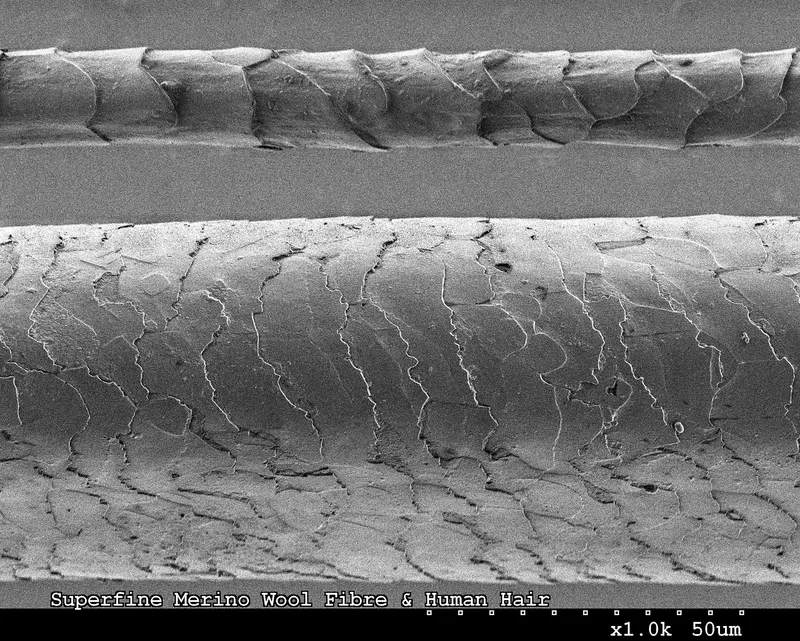
Every hair fibre is naturally porous: it contains tiny pores, mostly just a few nanometres across, and it swells as it takes up water. Damaged hair is far more porous. Laboratory studies show bleaching sharply increases the number and volume of pores — one study found oxidative bleach nearly tripled the hair's surface area within the first minute. Harsh cleansing and other chemical treatments can increase porosity too.
In practice, people describe hair as "low porosity" (slow to get wet, slow to dry, products seem to sit on top) or "high porosity" (soaks up water and product quickly, dries fast, tangles and frizzes easily — often after bleaching, colouring or lots of heat).
Can you test it at home?
The popular "float test" — dropping a clean hair into a glass of water and seeing whether it sinks — has not been validated. We found no peer-reviewed study showing it measures porosity reliably; scientists measure porosity with laboratory methods such as gas sorption and thermoporometry. Judge porosity by how your hair behaves, and by its history: bleached, coloured or heat-styled lengths are likely to be more porous than your roots.
What helps more-porous hair
- Conditioner after every wash, and a richer mask now and then (see conditioning).
- Gentle detangling, because damaged hair breaks more easily.
- Moderating heat and bleaching — see safe heat styling and colour-treated hair.
Density
Density is how many hairs grow on your scalp, usually measured in hairs per square centimetre. It varies a lot between people, between areas of the same scalp, and with age. In one study using magnified photographs of the scalp, density among 38 African volunteers ranged from 90 to 290 hairs per cm², with an average of about 190, compared with about 227 in a group of white volunteers. A study of more than 1,400 white women found density was highest between 20 and 30 and fell with age — though hairs got thicker into the mid-30s, which offset some of the loss.
Density matters for how much product you need, how long hair takes to dry, and how a style sits. Gradual loss of density, especially on top, can be pattern hair loss.
Strand thickness
"Fine", "medium" and "coarse" describe the width of each hair, which is different from density: you can have lots of fine hairs or fewer thick ones. There's no agreed numeric definition of these labels. Thickness varies between people and populations, changes with age, and can differ across your scalp.
- Fine hair is easily weighed down — lighter conditioners on the ends often suit it better.
- Coarser hair can usually take richer products.
Not medical advice. This guide is general information from the sources listed, not a diagnosis or a substitute for a pharmacist, GP or dermatologist. If you are worried, or symptoms are severe or not improving, get advice. Read our health information policy.
Sources
- Gavazzoni Dias MF. Hair cosmetics: an overview. Int J Trichology 2015 pmc.ncbi.nlm.nih.gov
- Hessefort Y et al. True porosity measurement of hair. J Cosmet Sci 2008 pubmed.ncbi.nlm.nih.gov
- Habe T et al. Thermoporometry measurements of human hair. Int J Cosmet Sci 2025 pubmed.ncbi.nlm.nih.gov
- Kaushik V et al. Hair porosity quantification. Int J Cosmet Sci 2022 pubmed.ncbi.nlm.nih.gov
- Loussouarn G. African hair growth parameters. Br J Dermatol 2001 pubmed.ncbi.nlm.nih.gov
- Robbins C et al. Hair diameter and density changes with age in caucasian women. Br J Dermatol 2012 pubmed.ncbi.nlm.nih.gov
- Callender V et al. Classification of high curl pattern hair: a systematic review. J Cosmet Dermatol 2026 pmc.ncbi.nlm.nih.gov